Thursday, November 1, 2018

Making Predictions

Making Predictions

This week, I had the opportunity to go into two first grade classrooms and co-teach with our EL teacher. Our lesson focus was on making predictions before, during, and after reading. Before the lesson was taught to both classses, Mrs. Hildreth, Mrs. McIntire, Mrs. Murphy, and myself collaborated by email for specifics regarding the lesson. I started the lesson using an anchor chart and defining what a prediction was and when and how readers make predictions. Mrs. Hildreth jumped in and introduced the sentence stem that ALL readers can use when making a prediction. The sentence stem we used today was, "I predict that ______, because _____." 

Mrs. Hildreth had the students practice repeating the sentence stem before the students tried it on their own. Before practicing it during reading, we practiced making predictions using pictures. Mrs. Hildreth and myself modeled how we "turn and talk" and using the sentence stems. Then the students were given the opportunity to turn and talk with their partners using the pictures. We would then have students share out, using the sentence stems to answer. 

The final part of the lesson focused on making predictions as we read. We used the book, "Duck on a Bike". We made predictions before we read, during the reading, and after. We talked about if we could verify our prediction or if our prediction was left unanswered! 


Thursday, October 25, 2018

Restating the Question

Restating the Question

Today I had the opportunity to visit Mrs. Castetter's 4th grade classroom and do a lesson on restating the question when writing your answer. We began the lesson by connecting to the the YES! MAAM! Our focus was on just the first M--Me--Repeat key words from the question and provide a general answer. 

We started with reviewing the anchor chart and using turn and talks as we came up with the answer and practiced putting it in a sentence. 


Students then went back to their seats and we practiced getting our thoughts on paper. Students were asked to write two answers to questions and then we flipped the task and students were asked to write the question when given the answer! 


Below are student examples--We did questions 1 and 3 together as a class. Questions 2 and 4 were done independently and then students shared their answers. 
                                                                

Tuesday, October 16, 2018

Close Reading with Google Classroom Integration

Close Reading

Over the past week, I had the opportunity to visit Mrs. Hochstedler's room and continue our work on close reading. Instead of a nursery rhyme, we used the book, Room on the Broom by Julia Donaldson. This particular texts is great to use for so many different comprehension skills. The first day of this lesson focused in depth on characters, setting, and sequencing with the integration of using Google Classroom. We spent time showing students how to join the class, where to access items posted by the teacher, and how to turn in the assignment. The students were given a Google Slide where they had the opportunity to type and move pictures to sequence the story!
Here is the original teacher doc:
Add caption
Here is a student document after we completed the task:
On day two, we reviewed phase one, but turned our focus on phase 2 and phase 3. Since our focus was on reading comprehension and underlining words that we didn't know the meaning of, I was the reading voice for the students. As I read, students underlined words that they didn't know the meaning of. After we finished, a student would say a word, and then myself or a friend would clarify the meaning of the word.
Student Sample 1:


Student Sample 2:


 Our final stage of close reading focused on two questions, "Why do you think the animals helped the witch?" and "What happened next after the witch made the truly magnificent broom?" Answers to question 1 included: The animals were kind. The animals thought the witch was a good witch and wanted to help her. The answers to the second question included: "The witch dropped her cauldron and another animal helped pick it up." and "The animals continued to save the witch from the dragon."


Slide for Phase 1: Room on the Broom Phase 1 (Please just make a copy if this is something you would like to use in your classroom)

Copy for Close Read:


Thursday, October 11, 2018

1st Grade Lexia Data Lesson

Lexia Data in First Grade

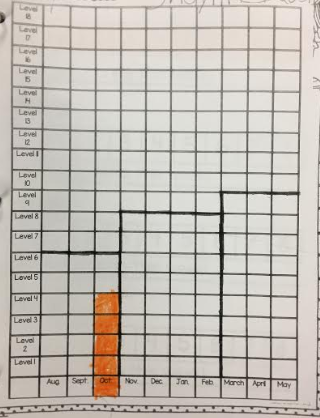
Today I had the opportunity to visit Mrs. Kiel's first grade classroom. Our focus today was taking a look at our Lexia Data. First we talked about what levels first grade students should complete by the end of the year. I broke it down even further for them and set goals as to which levels they should be working on during the beginning of the year, mid year, and end of the year. From months August through October they should pass level 6, from months November to February they should pass level 8, and from March to May students should complete level 9. I had each student look at what level they were working on and color it in on their Lexia Data Graph. 

As a school we talk a lot about getting our minutes in, so today we talked about gaining those units throughout the week. Students in her room were unaware how they gained those units, so I explained that to get a unit they must fill up their blue bar across the bottom.Working with Mrs. Kiel, we set a goal for passing at least 8 units during the week. They were given a sheet where they can record their units gained each week for a month at a time! 
\

Here are some of the students Data Sheets from our lesson today: 


Mrs. Kiel is putting these in their data binders. 
I have attached the images for first grade! I can send you the documents if that is something you would like to implement in your classroom! I can also change these to make them work for your grade level.


Wednesday, September 26, 2018

Kindergarten Math Lesson

Kindergarten Talk Moves and Close Reading

Today I had the opportunity to visit Mrs. Smith's Kindergarten Classroom. Our focus was on math discourse and getting the kiddos to talk and listen to different opinions using "Which One Doesn't Belong?"


To begin the lesson I introduced talk moves. Talk moves allows every student to engage in the conversation by signaling different motions with their hands as they hear students talk or if they want to answer. In kindergarten, we focused on only three of the talk moves: Thumbs up to answer, pinky and thumb out to agree to a students answer, and both fist together if another student wants to add on to a students answer. Talk moves are great to keep every student engaged in the conversation.


After introducing talk moves. Students were partnered up and we turned to our lesson focus. Students were showed a power point and had to decide which one didn't belong. In each slide there is more than one reason that one of the pictures doesn't belong. Students used talk moves to answer which allowed myself to know which students were engaged and who wanted to add to the conversation.

I had students use the sentence stem, "The _____ doesn't belong because _______. This was great for our English Language Learners.
Student answers to the picture above included: "The triangle doesn't belong because it only has three sides and the other shapes all have four." and "The diamond doesn't belong because it is not shaded in"

To the left answers included: "The purple dice doesn't belong because it is purple and the others are white." "The 5 doesn't belong because it is the only number and the others are dots." and "The one doesn't belong because all the rest show 5 and that dice only shows 1.

Here is a link to the slide show I used to introduce talk moves and Which one doesn't belong.
Slideshow

Her is the address for more "Which one Doesn't Belong" scenarios to use in any grade: Which One Doesn't Belong

Let me know if you would like help implementing this in your classroom!


Tuesday, September 25, 2018

1st Grade Close Reading

1st Grade Close Reading

Yesterday and today I had the opportunity to visit Mrs. Hochstedler's room and continue our work on close reading. 


Yesterday, we worked together with the nursery rhyme, Jack and Jill, to practice the 3 phases of close reading. In phase 1, we read for general comprehension and understanding. In phase 2, we read again and circled any unknown words that we didn't know the meaning of. In phase 3, we read for the final time to answer the question, "Why did Jack go to bed?. The students had to support their answer. 


Today the students worked independently with the nursery rhyme, Little Miss Muffet. I began the lesson by reviewing the three stages and what happened during each stage.
Phase 1: Their first task was to go to their seats and read the nursery rhyme 2 times on their own. After completing their reading, they were to come back to the front to show me they were ready to discuss the characters, setting, story sequence of the nursery rhyme. 
Phase 2: Students were to return to their seats, reread the nursery rhyme, and circle words that they didn't know the meaning of. Students were also asked to determine the authors purpose of writing the nursery rhyme. As the students were working, I noticed that I needed to clarify that we were underlining words we didn't know the meaning of and not words we did not know how to read. After students were done reading, I called on a student to say a word they didn't know the meaning of. That allowed for other students to help clarify the meaning to the students. Mrs. H has also implemented talk moves which helped me check in with all the students on whether they agreed, wanted to add more, or needed more clarification. 
Phase 3: During phase three, students read for the final time, to answer the question, "Why did the spider sit down beside Miss. Muffet?" Answers from first graders included: "The spider was hungry and wanted some food." "The spider wanted to bite Miss Muffet." and "The spider wanted to scare her away so it could build a web!"

I am so proud of how well these first graders are understanding the stages of close reading! I have attached the documents with the poems and pictures that I used during the lessons! Let me know if you would like help getting this going in your room! 


Friday, September 21, 2018

1st Grade Close Reading

1st Grade Close Reading

Today I had the opportunity to visit Mrs. Hochstedler's Room in 1st Grade. Our lesson focus was on close reading. We did a mini-lesson today on the 3 stages of close reading. I used Smeken's Close Reading Triggers set to introduce each phase so that the students could make a visual connection. I also used a familiar text that most of the students had already heard, Pete the Cat and His Four Groovy Buttons. 

Phase 1: I introduced this stage by wearing the glasses and talking about this phase is something that we do every time we read a story. We read to determine what is happening, who are the characters, where is the story taking place, and how the story ends.

Phase 2: I introduced this stage by getting out the microscope and had the students tell me the purpose of the microscope. I then modeled how we use that in the second phase of a close read. We may zoom in on unknown words, why the words are written the way they are in the book, and what the author's purpose is for writing.

Phase 3: I introduced this stage by getting out the telescope. Again, the students told me the meaning and we connected it with close reading. We "zoomed out" to determine "Why we thought Pete sand his happy song even after losing all his buttons". Stage three involved making text-to-text connections and/or using text or pictures to support our answer, 


Mrs. Hochstedler's Class did a great job today. Stay tuned as I will visit Mrs. H's Classroom on Monday morning and the students will work more independently on a close read using a nursery rhyme!