Thursday, February 7, 2019

Paired Texts

Paired Texts

Over the past week, I had the opportunity to go into our third grade classrooms and work on comparing two texts. We used Damon Bailey versus Romeo Langford articles. Students navigated to these articles using Google Classroom.While reading students filled out their Romeo versus Damon T-Chart. The T-chart allowed students to compare Damon and Romeo's middle school, high school, and college careers, as well, as after college. We read the article together and as we read I would pause to have students share what they learned. They recorded those thoughts in their T-Chart. After reading, students navigated to a Google Document were they checked the statements that applied to each player! The students loved learning about All-Stars from our state!
Here are some student examples from the lesson: 


Here are the links for the lesson: 

Thursday, January 24, 2019

YES MA'AM

YES! MA'AM

Today I had the opportunity to go into Mrs. Beavers's Classroom and continue our work with YES! MA'AM. Our focus today was to put a whole YES! MA'AM together.  We began the lesson by reviewing how to write a Yes! MA'AM: Restating the question and providing an answer/inference, citing evidence using a sentence starter, and closing it by restating the answer/inference.  Students then went back to their seat and read the Newsela article: "Driverless Cars, Flying Cars, and Now Walking Cars".
                              

After reading students answered the question: "Elevate" was introduced by Hyundai at a car show in Las Vegas. What sets "Elevate" apart from other cars? Use two details from the text to support your answer. We used a scaffold today with the four boxes and students were also provided the sentence starters. Students worked on one part at a time, and then we checked back in whole group.
Here are some examples from today:
                              

Driverless Cars, Flying Cars, Now Walking Cars
Yes MA'AM Template (just add sentence starters for support)

Friday, January 11, 2019

Yes MA'AM

YES MA'AM

Yesterday I had the opportunity to go into Mrs. Beavers's 4th grade classroom. Our lesson focus was writing a constructed response. We reviewed the YES! MA'AM checklist to begin the lesson. See it below!

Our Article was from Newsela (which already has an embedded constructive response for EVERY article). The question was, "What is the overall central idea of this article? Use at least two details from the text to support your answer." The students used turn and talk to pull out details. We also talked about using the exact words from the article.


We started the YES!! MA"AM by giving our answer to the central topic of the article and restating the question. We then 

Today we practiced whole group, next week, we will practice more individualized and with Chromebooks.

Link to PDFs used:
YES MA'AM POSTER
CONSTRUCTED RESPONSE TEMPLATE
NEWSELA PDF

Thursday, December 20, 2018

3 Act Math Task

3-Act Math Task

Over the past week, I have had the opportunity to go into our first grade classrooms and preform a 3-Act Math Task. The 3-Act Math Task allows for students to engage in math conversation and share their ideas. Most of the lessons begin with a short clip or image that doesn't give away large amounts of information. 
In Act 1 teachers ask students: What do you notice?, What do you wonder?, and What is your Estimate?
In Act 2 teachers ask students: What information do you need to solve the problem? and How are you going to solve the problem?
In Act 3 students take the lead and share out how their thinking and how they came up with their answers. 
Before starting the lesson I introduced our recording sheet. The first box is where students make an estimate. We talked about what it means to estimate and how we can make a good estimate. The second box requires students to draw a picture to help them solve their problem. The third box asks for a number sentence to show their thinking. The final box asks for their answer. 

Our 3 Act Task was titled "Humpty Dumpty" The short clip shows a little girl opening up the fridge and a carton of eggs drops out. The question posed to the students is: How many eggs broke? As we worked through the Acts the students were given more information. 

This is not just for first grade but can be used for ALL grade levels. Here is the link to all of  Graham Fletcher's 3 Act Task: 3 Act Task Link.

Tuesday, December 11, 2018

Listening Station Idea

Listening Station In Kindergarten!

Need a listening station idea? Don't have enough CDs to make your listening station last all year long? Are you students struggling to share 1 or 2 copies of the book? Mrs. Smith and I have collaborated and changed how her listening station looks. 

We replaced her CD player with enough Chromebooks for each student at the Listening Station. With the use of Google Classroom, Mrs. Smith, attaches YouTube videos of books being read aloud for the students to listen to during their station. She has posted simple picture directions for students to log in to the Chromebook and Google Classroom (Yes--all 30 of her kiddos are doing this)! 

Some things to know when assigning these YouTube videos to Google Classroom:
1.Listen to the video you are selecting--some readings are WAY better then others! 
2.Most of the links say NOT APPROVED FOR SCSC.K12.IN.US. Which means students will not be able to watch it if pushed out to their Chromebook through Google Classroom.
TO FIX THIS PROBLEM:
TRY THIS FIRST: If you hit the white approve box, it may or may NOT approve. You may check it by assigning it to Google Classroom and then checking it with a students Chromebook (must be through a students login--it will ALWAYS work with your login)
TRY THIS SECOND: Go to the Website Block/Unblock Form by clicking on the purple link. Fill in the information (takes 1-2 minutes). Submit the form. A copy should send to your email and Mr. Rodman will approve the video (usually takes 24 hours)! Then you can link the video to Google Classroom! 

Here are some pictures of her listening station in action:


Let me know if you would like help implementing this in your classroom! 

Monday, November 26, 2018

Close Reading with Multi-Step Word Problems

Close Reading with Multi-Step Word Problems

Today I had the opportunity to do a lesson in Mrs. Castetter's classroom. Our focus was breaking apart multi-step word problems and giving our students a guideline to use when working on a multi-step problem. Today we looked at a multi-step word problem through a close reading lens. With each read the students picked out more information that was important to the problem they were solving. See the anchor chart below to see the different phases:
The students and I did a multi-step word problem together. We talked through each phase of the reading. See our question and work we did together below:


The last part of the lesson allowed for the students to work out a multi-step problem on their own, but the students checked in after each read. See some examples of students work below:


Tuesday, November 13, 2018

Point of View

Point of View


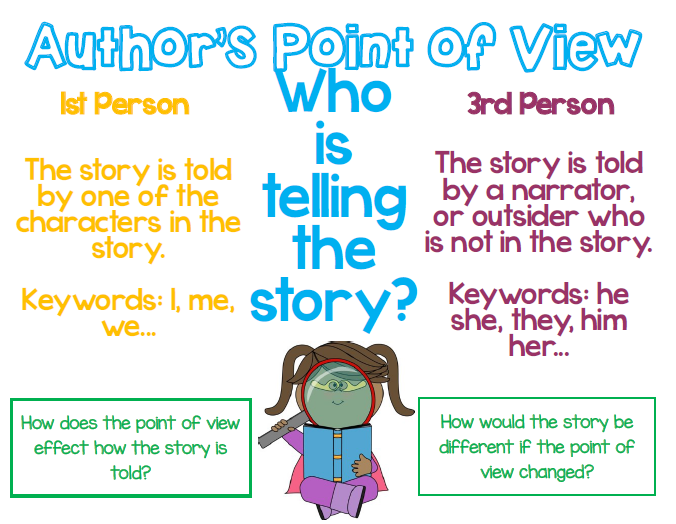
Recently I had the opportunity to visit all our third grade classrooms and focus on point of view. To begin the lesson we used an anchor chart and talked about the different points of view that a story can be told in. We also talked about how characters within a story can have a certain point of view depending on how the story is being told. 


We started the lesson by reading Creepy Carrots by Aaron Reynolds. At the end of the story we talked about what point of view the story was being told in. Then we talked about looking at the story through Jasper the Rabbit's point of view and the Creppy Carrot's point of view. The students noticed how Jasper loved to eat carrots because it was his food, they also noticed that the carrots didn't like being eaten and started to haunt Jasper. We used this chart to the left to record our thoughts.


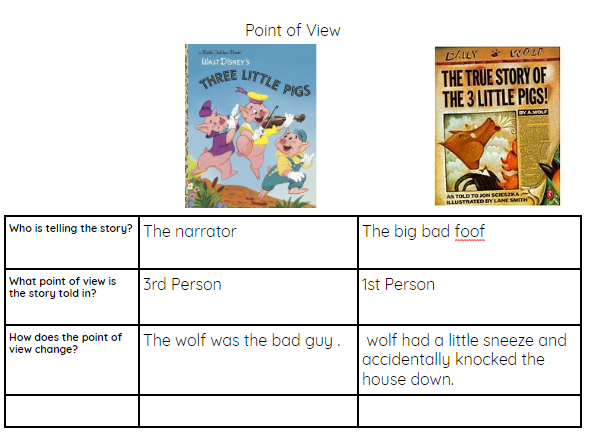
To end the lesson, we read, The Three Little Pigs and The True Story of The Three Little Pigs. Then students used a Google Docs to compare points of view from each story and how the points of view changed! Check out the Student Examples Below: